
As any engineer or scientist knows, when a magnet moves inside of a coil of copper wires it produces electricity. You could put magnets on the pistons and wrap the piston chamber with copper wire. It does not matter which one moves, the copper wire or the magnet, as long as one of them moves, an electric current will flow in the conductor (copper wire). Every generator or alternator in the world uses this simple principle and the thermal generator will make electricity using a very small temperature differential. After designing the thermal refrigerator and thermal generator, it became obvious to me that the valves should open outwards, not into the cylinder. But I didn't feel like changing my drawings.
The following design shows the same double chamber cylinder as the thermal air conditioning compressor, but it can just as easily have just a single chamber cylinder with four valves. The manufacturer can probably design it to operate both products, refrigeration and electricity at the same time or put in a switch to turn the double chambered-double piston refrigeration compressor between refrigeration and generator; back and forth. It would only take minor adjustments to the design. It just depends on the preferences of the manufacturer and the people’s requests.
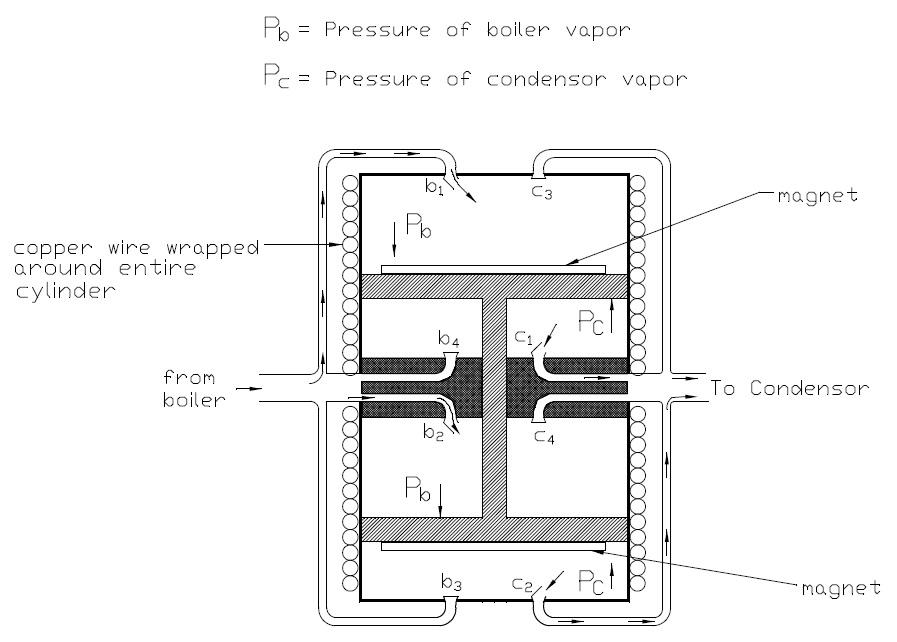
Notice that for the downward stroke, the two boiler valves b1 and b2 are open, which allows pressure from the boiler, Pb, on the two different piston faces. The condenser valves c1 and c2 are also open and the condenser pressure, Pc, pushes back against the boiler pressure Thus, allowing higher pressure from the boiler to compress the Freon vapor into the condenser where it will cool down to the outside ambient air temperature and corresponding pressure. I'm assuming the condenser is outside but it could be wherever you need it to be. On the return stroke the four valves close and now the other four other valves open, b3, b4, c3 and c4. This allows the same situation but now the boiling pressure is pushing up in two places as the condensing pressure is pushing back in two places.
In both the downward stroke and the upward stroke we have the equation that 2 boiler pressure points must be greater than 2 condenser pressure points in order for the piston to start moving and creating electricity.
So the equation becomes:
2 × Pb > 2 × Pc
Pb > Pc
This is the only equation that matters for the thermal generator to work. It is a very simple equation and it is all that matters. If you can get the boiler pressure to be higher than the condenser pressure, then you will have a working thermal generator. The boiler pressure is determined by the temperature of the boiler and the condenser pressure is determined by the temperature of the condenser. So, if you have a boiler that is hotter than the condenser, then you will have a working thermal generator. It is really that simple. You can use any two sources of different temperatures to run this generator, such as between your attic and outside air, or between your attic and ground, or between your ground and outside air, etc. You just need to have two sources of different temperatures to run this generator.
Since we can cancel out the 2's in this equation. This equation is always true when the temperature in the boiler (or in the attic) is higher than the temperature outside (or the ground if that is where you're using the condenser). This is usually the case in the day and part of the night as the attic takes a while to cool down after the sun sets. So, the boiler is basically working all daylight hours, making DC electricity. DC electricity is the same current that PV (photovoltaic) panels make. You can have a switch in the line to change the outside air to either of the thermal batteries to ensure (when attic drops too low) that your generator will continue working for you. You can also run the generator between any other two sources, such as between the attic and ground temperatures, ground and ambient temperatures, or whatever sources you have.
Electrical engineers design generators to have a certain voltage and utilize the number of copper wire loops around the generator, the strength of the magnet, as well as other engineering data to get the voltage they want. I'm not an electrical engineer and can't design an exact generator to do the job. But I know that my thermal generator principle will work. It is obvious to myself and every electrical engineer.
You have to turn the DC current into AC current, that your house runs on, with an inverter. You can buy inverters from any store that sells PV panels: Amazon, or even Walmart online. But you do need an electrical engineer to design the thermal generator wiring and magnet correctly so that you can get 12 Volt DC current when the piston moves. Generators are designed to pump out designated voltage, like 12 volts. Alternators are designed to put out alternating current, AC, which is what house current runs on. I learned about electricity way back in physics class, but that was several decades ago, and I don't remember a lot about it. I do remember that electrical engineers learn early on how to make a generator to do what they want.
The higher the temperature differential, the faster the generator will make electricity. It is also a good idea to run a thermal generator between the thermal battery and the ambient air outside for a steady amount of energy in the winter, or whenever the attic does not have sufficient heat. There are many other possibilities that you could think of to use small temperature differentials to power a thermal generator to make the electricity that you need. But it is a very good idea to have good thermal batteries. Having large thermal batteries means you have large energy batteries to provide you with energy (electricity if you need it).
This is especially true for episodes of blackouts or emergencies. The pipes can have a switch to change from attic boiling to ground battery boiling just like typical heat pumps use to switch gears between heating and cooling.
I haven't had the thermal generator built yet and I hope that some enterprising person will take my generator idea, test it for efficiency, and make it available to the public. Hopefully, more than one company will do it in order to have competition and thus, lower prices.
The average home attic will produce enough air conditioning and refrigeration to do away with a significant amount of the electric utility bill. When you install a thermal generator, it will probably take care of the rest of the bill. We won't know the efficiencies until electrical engineers build it and test it. The efficiency changes with every single degree temperature difference so we can only get a rough approximation of the efficiency if we state a given temperature difference. So, I will use an example of 130 ℉ (55 ℃) and 70 ℉ (21 ℃) using what's called a Carnot efficiency, which tells us the maximum efficiency that physics allows us to get for any thermal cycle machine. I did and the Carnot efficiency for the generator operates between these two temperatures is 10%. That means that, at most, my thermal generator will have 10% of the energy in the 130 ℉ air turned directly into electricity and the remaining part turned into 70 ℉ temperatures. Power plants that use high heat to make electricity do so at about 70% of the Carnot efficiency. If we get 70% percent of the Carnot efficiency that would mean we are getting 7% total in turning our low temperature heat into electricity.
This seems like low efficiency but when you consider the only important thing; getting free electricity at low temperatures commonly available to us, it seems like a cool idea. I can live with that 7%, as long as it is free. You might find a use for the vapor heat that leaves the compressor before it goes into condenser. Once you start viewing low temperature heat as energy, you will start noticing a lot of things.
The thermal generator can run on any two sources that have different temperatures. The attic, outside air, the ground, your swimming pool, greenhouse, barn, etc., almost always have different temperatures so that the thermal generator can operate 24/7 every day of the year. If your attic temperatures are not warm enough to do away with your electricity bill, then you will have to convert your roof into a better solar collector by changing your roof to a flat black metal roof. If not, then you will have to make some solar thermal panels to assist you. If not these, then you might need to use the air generator (later in this Chapter). If you make solar panels, make sure and use selective surface painted aluminum metal covered by tempered glass and position it at an angle equal to your latitude angle (measured from the horizontal). Unless you are willing to change the angle of the STP's, in which case, just point them directly at the sun when it is at its highest altitude of the day. Over the long haul, I think you are way better off having an effective giant roof solar collector and thermal batteries.
I hope, by giving my permission to build any of my designs without royalties, that several companies or persons will begin to mass produce systems in order to get the cost down to a reasonable price for everyone to be able to afford.
I know that this will seriously hurt utility companies, oil companies, coal, etc. and thereby will paint a big target on my back. That might have very negative consequences for me and my family from big money interests as well as political- induced problems, because of the many politicians that get big donations from big energy donors. And big money donors all have a lot of pull from politicians, judicial, and even the President. I'm hoping to get this book published before they have me in their sights so I can at least go to my grave knowing that I did what I could to help save the future of the planet. I know deep down in my bones that there are other inventors that have good energy saving inventions. I hope they will start taking my advice and publish their inventions freely before they are confiscated by the government using the Invention Secrecy Act of 1951. I even hope the congress will stop this insanity of the government but I also know that big money has a hell of a lot more political muscle than the common public, so I don't expect that to happen any time soon. At the very least, inventors should be able to challenge this stupid law in court and prove their invention does not have anything to do with national interests. Everybody deserves the right to prove their side in a court of law!!! This fact is a fundamental principle of freedom. Without it, we are merely living a dream of being free, when actually we are not free. If the government can deny one-person constitutional protections, then they can deny them to anyone they want! That includes you, your family, your friends, everybody! They just use unconstitutional laws that haven't been overthrown yet by the Supreme Court or by a grassroots movement. And that almost always takes a long time.
Do constitutional lawyers even exist anymore? Or do they just charge so much money that only rich people can afford them? Until we agree to make laws simple and easy to challenge in court without a high-priced lawyer, things will probably not change. Most politicians are lawyers and they like the laws complicated. They make a lot of money this way and have zero interest in changing the system. I hope I don't sound too mad but I'm infuriated and frustrated at the corrupt political system I live in and don't know exactly how to change it, like most people I suppose. It usually takes a rich person to challenge bad law all the way to the supreme court and rich people seem to like things just the way they are for the most part.
Utility companies can set up large scale solar thermal plants and if the thermal generator turns out to be more efficient than the current large scale solar plants then they could make electricity at low temperatures which would cost a lot less money than the very high temperatures they need to get to now. This would supply the electricity needed for the people that cannot afford or have the space to supply their own electricity (such as high-rise apartments, etc.)
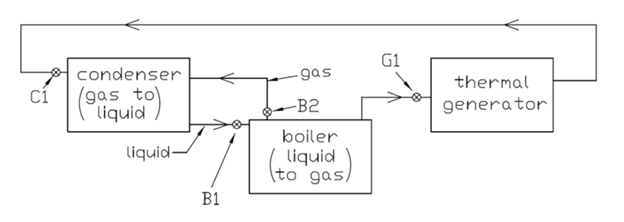
Condenser valve is: C1
Boiler valves are: B1, B2, & B3
Generator valve is: G1
Very important! All pipes are well insulated (with one-inch-thick insulation (25 cm)) except the ones inside the boiler, condenser, or generator. Never insulate the condenser or the boiler as they need to transfer heat to or from their surroundings as quickly as possible.
The backflow valve, C1 allows vapor to flow into the condenser, not out. It is a one-way- valve at all times of operation. Let's start with the condenser 80% full of saturated refrigerant (both liquid and vapor exists together). Valves B1 and B2 open at the same time to allow all the liquid refrigerant to flow into the boiler through valve B2, while B1 allows the condenser to fill up with boiler vapor to replace the liquid that is flowing out. This keeps a partial vacuum from taking place in the condenser, which would impede the flow of refrigerant into the boiler. As the condenser empties, the valves B1 and B2 now close, while valves B3 and G1 open to begin operating the generator. As the boiler vapor flows into the condenser, it is allowed to return to the lower condenser temperature and pressure, and condense back into liquid, usually assisted by a small fan. This repeating cycle goes on for as long as there is a temperature difference (and the pressure difference with it). No feedwater pump needed, which is the same for all my designs.
And the generator is always working while the piston is going in either direction; except when it stops for the boiler to refill liquid refrigerant from the condenser. That only takes a minute to accomplish. The generator is always able to work when it has two sources of different temperatures. They can be small temperature differences, but the bigger the temperature differential, the faster and more efficient the generator will turn low temperatures into electricity. As I have stated before, you will always have at least two sources of different temperatures between the attic, outside air, and ground temperatures (especially if you have hot and cold thermal ground batteries).
The current steam turbines almost always use water steam at high temperatures. This is because the physics tell us that the higher the temperature difference, the more efficient the turbine (or generator) will be. The big turbines their selves, operate at 85% to 90% efficiency, while the thermal generator skips the turbine altogether. I have high hopes for it as electrical engineers play with the exact design and wiring to make the thermal generator as efficient as they can.
I have never heard of anyone using a refrigerant as a working fluid as of yet and I have always found that strange. But I have always found it just as strange that no one is taking advantage of low temperatures. You need to use a refrigerant at these relatively low temperatures because you cannot use water unless you put the entire system under a vacuum so that the water will boil at low temperatures. And since water freezes at a mere 32 ℉ (0 ℃), it is difficult to use in some situations. In addition to this problem, the water pressures will be very low under the vacuum needed and that means very low generator output. When operating a thermal generator, we want pressures that are relatively high. So, we must use refrigerants for the working fluid.
I continually stress that you should operate all the thermal appliances you want before using the rest to make electricity because converting low temperatures into electricity is very low efficiency. Of course, free is FREE! So who really cares what the efficiency is. Make all you need.