
According to the U.S. Energy Information Administration, out of all expenditures on energy (including vehicles, heating and cooling, etc.) the average home in the United States uses a significant amount of it on air conditioning. Eliminating the electricity used for air conditioning and refrigeration would get the U.S. off oil dependence very quickly, all by itself. In my senior year of studying physics in undergraduate school, I designed a thermal compressor motor for air conditioning a home or running a refrigerator that will use only the temperature differential between the heat naturally occurring in the attic of the home and the outside air. It uses the heat in the attic and dumps it into the outside air where the condenser sits while operating an a/c compressor or refrigerator compressor. It runs on simple heat or thermal energy not electricity. I spent most of my time quite ill and had to quit or drop out of school more times than I can remember. But it was a very difficult time getting my degrees and it took many years of effort. I thought about just giving up hundreds of times (maybe thousands) but I'm thankful that I was able to earn a Master's degree in engineering, but that is as far as I got
I will explain the operation of a simple air conditioning system or refrigeration system first, so that you can more easily understand the thermal a/c compressor. An electric a/c compressor motor runs both refrigeration and air conditioning in the same way. The compressor does almost all the work which is needed to run the system other than a fan to cool the condenser which doesn't take much electricity. Fans are notorious for only using a small amount of electricity compared to other appliances. The valves may need to be electrically operated as well, but thousands of valve types are sold by manufacturers. Valves use a lot less electricity than even fans. It is so small it is difficult to calculate so most people just call it insignificant. The compressor of any cooling situation takes up almost all of the energy whether electrical or otherwise.
The attic of the home in the summer can get quite hot, especially in places like Phoenix, Arizona. If you want to know how hot it gets, go up in your attic during a warm summer day and see how long you last. It usually feels like a sauna. This is wasted energy that could be used for many purposes. Why not turn your entire attic into one giant solar panel? Use dark flat black painted metal roofing and your attic instantly becomes a giant solar collector and can be used for a variety of useful appliances, heating your hot water, operating your air conditioner, operating a thermal generator to make electricity, etc. Your attic temperatures are almost certainly able to make the air conditioning that you currently use, without changing your roofing at all, but it may not get hot enough every day of the year, for all your energy needs unless you alter your roof a little like using flat black metal roofing. Making thermal batteries to use to store high and low temperatures may be all you need to heat and cool your home all year all by itself. Your attic will not get as hot as it does in a solar panel but considering the costs, it makes sense to change your roofing and get the temperatures as hot as you can. That will most likely be all you need in most climates. If you decide you want to make more electricity to sell back to the utility company then you might want to change your roof or build an air generator (described later in this Chapter).
Solkote is what solar panel manufacturers use to make solar panels hotter and more efficient. Currently, the modern home uses various methods to keep their attic from getting very hot and humid such as vent fans or modern convection vents. Such a profound amount of energy wasted heating up the outdoors in the summer! Engineering schools need to have classes that teach young engineers to design ways to use natural energy instead of concentrating on using electricity. I understand it is convenience, but the time will come when everyone can see its destruction of the environment. Particularly burning fossil fuels to make electricity! Maybe it will happen when gas pump prices go to $20 or $30 a gallon (4.52 or 6.79 euros per liter) or electricity bills go up to thousands of dollars or euros a month
I know, by common sense, that the big majority of people will say, “oh, that will never happen”, but I promise you that it has happened in the past, and it will happen again and this time it will be much worse than before. Before the great oil embargo of 1973, people would have laughed if you said the day would come when the gasoline prices would go up by 400% in a single year. But that is exactly what happened in 1973. The price went from 25 cents per gallon to over $1 per gallon IN ONE YEAR! The economy went berserk. If the oil companies (including the American oil companies) decided to pull this fiasco again, our current prices would go up fast to $20/gallon or more. They decided to do that, just to increase the prices and the governments decided to NOT do one single thing about it. So very many of them said they were going to do something about it, and there were even some much advertised congressional hearings, commissions, and other things that were going to do something about it but in the end, they never did a single thing. The Big Oil conglomerate just had too much political power and too much power over our economy to threaten, that it scared politicians into doing nothing. Some politicians were getting large amounts of money from oil companies and some were just scared of their power but the outcome was the same. It had nothing to do with short world oil supplies; it was only about making more money. Some people cannot have enough money, they are obsessed with getting more, and more, and more. Imagine what would happen if they suddenly felt like we were using up oil too fast or just got overly greedy again. They very apparently don't mind crashing economies and badly disrupting human life all over the world, so don't expect them to suddenly start caring about us! Use your common sense. If you are thinking that “it won't happen again because our politicians won't allow it now”. The oil companies and the politicians have not changed! The oil companies still donate millions to each election cycle to both major parties and they are still seeking more power and more money. They are holding us hostage and taking as big a piece of our paychecks as they want and can bring us to our knees anytime they want. THIS SITUATION WILL CONTINUE TO EXIST UNTIL WE GET OFF OIL!!!
I had a team of engineering students at the University of Idaho do their senior project by constructing my design of a thermal a/c compressor. The built a prototype, verified that it worked as designed, and ran computer modeling to determine the efficiencies. IT WORKS!!! using low grade heat that you can easily get in your attic or solar thermal panel.
Every thermal cycle motor in existence needs a temperature difference of two temperatures (pressures) in order to work, such as steam engines, vehicle engines, turbines, refrigerator compressors, etc. That is a fact of life that I have never seen any different.
Absorption refrigeration is a different cycle of refrigeration cycle that doesn't use electricity to operate but rather a very high thermal difference such as a propane flame and the ambient temperature. This kind of system requires two temperatures of hundreds of degrees difference to operate. If you have an RV and have a mini fridge then it probably runs on the absorption cycle using a propane Tank and uses a lot of propane to operate. They are very inefficient, costly, and unfortunately, very dangerous. It is the number one reason for RV fires and in addition, they use very dangerous and explosive chemicals such as ammonia and hydrogen. That is why they are rarely used except in RV's and where the heating source is nearly free. Absorption refrigeration is currently near 20% efficiency. The Japanese currently own the market in absorption refrigeration and spend millions of dollars a year trying to get the efficiency up by one point or more.
--Backstory--
Before I explain the thermal compressor to you, I need to explain something about its coming into existence. In the late 1990's I started graduate school at Idaho State University. I finally got the nerve to show my advisor in graduate school and the chair of mechanical engineering, who I had respect for, a couple of my designs. I just wanted to know for sure that I was not a delusional inventor, of which I have known a few. Their comments led me to believe that I was onto something significant. I asked them to not say anything to anyone about my designs and they agreed.
A couple of months later, I got a strange phone call from a man claiming to be an electrical engineer in Texas. He said he was very interested in my solar ideas and wanted to quit his job and come to the university and study solar engineering with me. I thought that was highly unusual and didn't even make sense to me, but I answered a few of his questions. Someone had apparently told him of my solar thermal compressor. I was clearly upset at this point, and I excused myself and hung up. I realized someone I trusted must have told this guy about my invention. A week later my house was broken into, my door had been hit by something heavy, and my mobile home door was in pieces. After much searching, it became obvious that the only thing they stole were my notes on my inventions, including the solar thermal compressor. Calling the sheriff, who was in a small town about 16 miles away, did little good since my house was so isolated and there were no witnesses, so I finally told him to just forget it.
Years went by, I moved to a city in north Idaho, and went to an inventor's meeting. A rich man who was very interested in investing in the thermal compressor and told me to do a patent search. I did and found my exact thermal compressor in the U.S. patent records under “thermal compressor”. The description was my exact notes, word for word. I was devastated to say the least. It had been patented soon after my house had been broken into. I started mentally putting everything together. After thinking about it for quite a while I decided to have a senior design team work on my invention anyway. I let it go for a few years until the patent expired but have decided to publish all my ideas and a few that are good ideas from other inventors. A few months ago, my son and I decided to do a patent search and try, once again, to find this mysterious person that patented my compressor. I was very curious why I haven't seen any of the thermal compressors in the market. I figured he would tell me that Big Oil had bought it and shelved it. But there was no longer a thermal compressor and no longer even a category for “Thermal Compressors” in the entire patent office. I had always thought that once you filed a patent it would always remain in their records. I guess I was naïve. I have no proof of it ever being patented. I have no idea if this is legally my compressor or not, but I will publish it and hope for the best. But, just in case, I will not claim that it is mine in case of possible lawsuits. I was not originally able to find this person that filed the patent. I talked to the Chamber of Commerce in that small town in California and she had never heard of him or the company he claimed to own in that town. I didn't believe in conspiracies, but I was serioulsly beginning to wonder.
You could even use the ambient air and the ground temperature for your temperature differential, if that suited your purposes better. And if you have a pond out back, you could utilize that. It will also work in the winter using the temperature difference between the warmer attic air and the colder outside air or even the cool ground temperature and the ambient temperatures. You can even operate the a/c compressor between your hot and cold thermal batteries, etc, to run the refrigerator/freezer. You can use a reversing valve, such as the one heat pumps use, to switch between sources used for your hot source such as attic and ground.
I had a 5-person senior design team at UI build my thermal a/c compressor in 2013. One of the engineering students had a family emergency and had to leave school for a good part of the semester. That person was the team member that was assigned to find workable valves for the compressor motor and did not have time to complete the assignment. So the valves had to be operated by hand to demonstrate to the professor that it worked as designed. Therefore, the valves would only operate as fast as the students could operate the valves (slowly). But it was mainly built to establish if the compressor would work, so mission accomplished! I have drawn the compressor and hope that someone will finish my mission to get this out into the world as soon as possible. I believe you could make a huge amount of money! And you have my complete permission to do so.
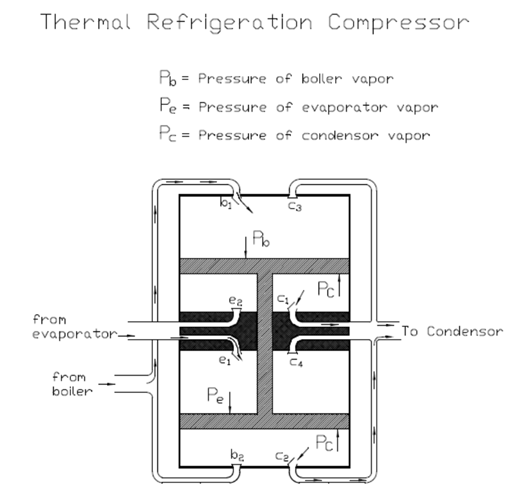
The compressor is shown with four valves open, valves b1, e1, c1 & c2. The pressures involved are from boiler vapor pressure, evaporator vapor pressure, and condenser vapor pressure. Force equals the Pressure times Area of the piston so we can, in this instance, use force or pressure interchangeably in the equations. The boiler pressure plus the evaporator pressure, together, must be greater than the two condenser pressures: Pb + Pe > Pc + Pc. At the end of the stroke, the four valves close and the other four valves open causing the piston to return to its top position. The cycle completes and begins again as long as the pressures in the boiler and evaporator combine to be more than twice the pressure in the condenser.
Some facts about R32:
| Location | Temperature (°F) | Pressure (psia) | Temperature (°C) | Pressure (kPa) |
|---|---|---|---|---|
| Evaporator | 45 | 147.7 | 7.0 | 1011.5 |
| Condenser | 70 | 220.5 | 21.0 | 1515.8 |
| Boiler | 90 | 296.0 | 32.2 | 2039.8 |
Just as an example, Let's see how these pressures at these temperatures affect the thermal compressor. The condenser is kept outside at the ambient temperature of 70 F (21 ℃)The boiler is kept in the attic which is at 90 ℉ (32.2 ℃), which is very easy temperature to reach in the attic. We want to use just the air conditioner to cool the inside of the home, not to run the refrigerator, yet. It will follow.
The equation becomes:
| Imperial | Metric |
|---|---|
| Pb + Pe must be greater than 2 times Pc | Pb + Pe must be greater than 2 times Pc |
| Pb + Pe > 2 × Pc | Pb + Pe > 2 × Pc |
| 296 psia + 147.7 psia > 2 × 220.5 psia | 815 kPa + 370 kPa > 2 × 570 kPa |
| 443.7 psia > 441 psia | 3051.3 kPa > 3031.3 kPa |
The equation is true; boiler pressure plus evaporator pressure is greater than twice the condenser pressure, so the compressor starts working at these temperatures and provides air conditioning to the inside of the home using the temperature differential of 20 ℉ (11 ℃) from 90 to 70 ℉. When the ambient temperature outside gets hotter, the attic will obviously get hotter and the compressor will work harder and provide more air conditioning. In actual practice you will need a slightly higher temperature difference to overcome the small amount of friction involved in working the piston, but it shouldn't be more than a degree.
If you need to operate a refrigerator/freezer at 10 ℉ (-12 ℃) you will need a temperature differential of 34 ℉ (19 ℃). Let's prove that, using refrigerant R32 again:
| Location | Temperature (°F) | Pressure (psia) | Temperature (°C) | Pressure (kPa) |
|---|---|---|---|---|
| Evaporator | 10 | 78.2 | -12 | 543.3 |
| Condenser | 70 | 220.5 | 21.1 | 1520.4 |
| Boiler | 104 | 364.3 | 41 | 2539.3 |
Using the equation:
| Imperial | Metric |
|---|---|
| Pb + Pe > 2 × Pc | Pb + Pe > 2 × Pc |
| 364.3 + 78.2 > 2 × 220.5 | 2539.3 + 543.3 > 2 × 1520.4 |
| 442.5 psia > 440 psia | 3082.6 kPa > 3040.8 kPa |
The statement is once again true and the compressor will work at these temperatures operating a refrigerator/freezer.
The design uses free energy in the attic temperatures. It starts working at a mere 20 ℉ (11 ℃) degrees temperature differential to make air conditioning and 34 ℉ (19 ℃) temperature differential to make a freezer work; if 10 ℉ (-12 ℃) is the desired freezer temperature. The higher the temperature differential the faster it works. So you can put the boiler in the attic, the compressor outside to cool down in ambient air, and the evaporator in the home to make refrigeration or air conditioning. The hotter the temperature gets in the attic the faster it will work and proportionately so, bringing down the temperature in the living space faster. The system is paired perfectly for the job. Or you could use a few solar thermal panels if for some reason to have to resort to that instead of the attic. In addition to this, you might find other uses for the hot and cold temperatures coming out of the compressor before they can get to the condenser.
If the outside temperature is 70 ℉ (21 ℃) and you just wanted to make 60 ℉ (15.6 ℃) then you would only need a small temperature difference.
The thermodynamic cycle is presented in the following figure:
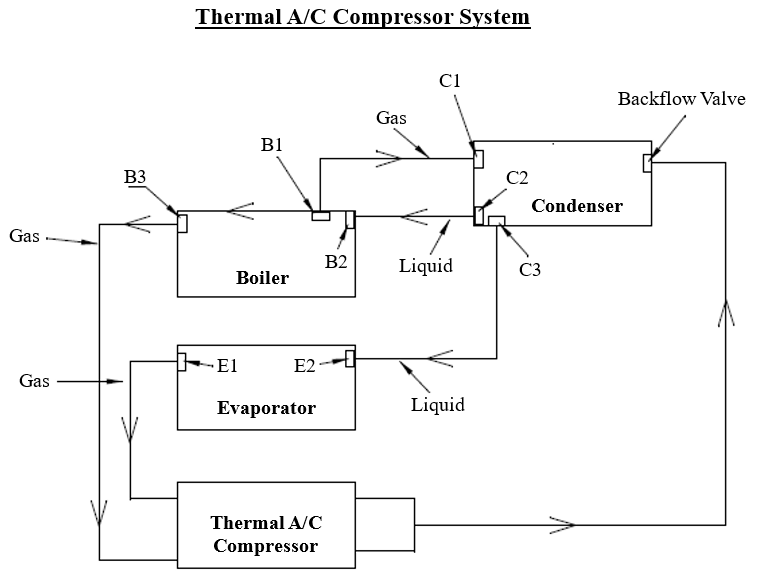
For air conditioning, the COP (coefficient of performance) is 0.445 for the temperatures stated in the example. That means that the a/c compressor takes 2.25 units of attic heat to remove one unit of cooling. An electric compressor can get a COP of 3 or 4. That sounds like the thermal compressor is doing poorly, which is not the case at all. Solar energy is a low quality energy source that is free, while electricity is a high quality energy that is costly both in terms of money and usually pollution, as well as eliminating our natural resources. You cannot compare the two energy sources. The higher the energy quality, the costlier it gets. And using a high quality energy to make a low quality thermal energy is crazy!
Physics scientist have developed an equation that has never been defied. It is called the Carnot efficiency equation. It tells us, using absolute temperatures what the maximum efficiency that is physically possible to get from a thermal cycle (such as a turbine turning a generator to make electricity). For example, the Carnot efficiency for operating a heat cycle making electricity with low temperatures between 90 ℉ and 70 ℉ (32.2 ℃ and 21.1 ℃) is theoretically 3.6%. If it is real good, like the power plants are, we can expect to reasonably get about 2.5% efficiency. That means it would take 40 kJ of heat to make 1 kJ of electricity. Trying to turn low grade thermal energy into electricity is considered futile in the science and engineering fields. It has simply never before been done, to my knowledge. Certainly no one has ever gone public with that knowledge, if they have successfully done it. They have completely overlooked the fact that it is not only feasible but practical and FREE! And that is if we are using our current technology that we have today. I will show you, later in this Chapter, how to turn attic temperatures into electricity and a lot of other useful thermal appliances in realistic machines similar to the a/c thermal compressor and how to do so every day of the year.
The main idea here in this section is just to show you how to use relatively low temperatures that are commonly available to operate your refrigerator/freezer and air conditioning needs. And that you can get those temperatures using the energy in your attic, the outside air, a solar thermal panel, your water well, or the ground to do it. As well as operate all your energy needs (freezer, cooling, heating, cookstove, water heater, air compressor, television, etc). As I'm getting ready to publish my book, I have learned that once again the government has changed the legal production of the common Freons and replaced them with different Freons that have different properties and are more expensive. I'm not willing to take the time to redo all the information of R134a on all my designs. So I leave that up to you. You can get the data tables from refrigerant suppliers, any refrigeration repairman, internet or NIST: refprops software (Nist charges a lot of money but the others are free).
This is a much cheaper way to go than the cost to do the same thing using expensive PV (photovoltaic) panels or house current. You can use your PV panels to provide you with electricity that certain things absolutely need electricity for, like computers, lights, microwave etc., or use the thermal generator to make electricity for those things. That is until a thermal appliance engineer figures out how to run them on thermal energy instead of electricity. But the biggest part of your utility bill comes from the major appliances that thermal energy can provide simply and easily.
You probably already realize that you could use this same refrigeration system to operate your food cellar or cold storage room (Chapter 4), if you don't mind the expense of the mechanical system. You may be able to operate the cooling and freezing of the food cellar by the same thermal compressor being used for the home, if it is close enough to the home or has its own attic. It is just a matter of choice and availability of finances. You also can choose the water Tank system or the passive refrigeration system. You have choices. Either one will work but needs some effort on picking out valves and a thermostatically activated shut off valve to stop the system when you reach the desired temperature just like a thermostat for your living space or refrigerator. Maybe new thermal appliance engineers will develop new ways to run appliances (including vehicles) than I have. I hope so.
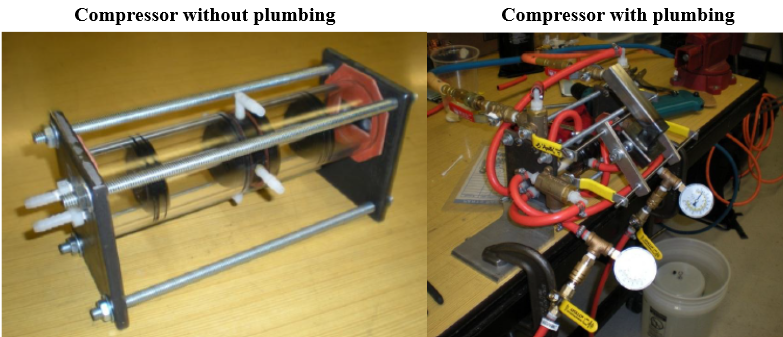
These pictures were in the report of the five-man engineering team of senior students. On the left is the bare compressor with the piston. The piston chamber was made with heavy plexiglass so that we could see the piston moving up and down to make sure it was working. This same thermal compressor can be reconfigured to make electricity. For more details, please see -Appendix for the full report, proof of concept, completed at University of Idaho.